Building a Resilient Sewer Workforce in the Age of Automation
CCTV inspection programs face two converging pressures: growing dataset scale and accelerating workforce transition. This whitepaper outlines how separating mechanical capture from analytical classification — and embedding expertise into structured workflows — builds a resilient inspection program that delivers consistent, defensible outcomes regardless of who is on shift.

A durable operating model for consistent performance amid workforce transition
Read the Full Whitepaper
Download the full SewerAI whitepaper — Building a Resilient Sewer Workforce in the Age of Automation — for the complete framework, detailed analysis, and actionable guidance for building a durable inspection program.
Executive Summary
CCTV inspection programs are under increasing strain from two converging forces: dataset scale and workforce transition. Inspection volumes continue to grow, and with them the demand for consistent, defensible condition data. At the same time, experienced operators are retiring, hiring pipelines are tightening, and incoming employees are less likely to build decade-long careers around mastering manual defect coding.
The traditional model, which requires field crews to simultaneously operate equipment and perform real-time condition assessment, does not scale cleanly under these conditions. When inspection accuracy depends heavily on individual interpretation, variability becomes embedded in the dataset. Five trained operators reviewing the same footage will produce five slightly different outputs. Across thousands of inspections, that variability complicates capital prioritization, regulatory defensibility, and longitudinal system analysis.
A resilient inspection program requires separating mechanical capture from analytical classification, embedding consistency into the workflow itself, and reducing dependency on scarce expertise in the field. Modern structured platforms and automated analysis models allow operators to focus on safe, high-quality video capture while standardized systems handle defect identification and quality control at scale.
The result:
- Reduced interpretation variability across crews
- Faster onboarding of new personnel without compromising output integrity
- Greater workforce flexibility across equipment and roles
- Lower cognitive load in the field, improving safety and execution
- Inspection datasets that remain consistent across generational workforce shifts
The objective is not to replace expertise. It is to embed expertise into the operating system of the inspection program. In a 100-year infrastructure environment, workforce durability must match asset durability.
Section 1 — Lowering the Skill Barrier Without Lowering Output Quality
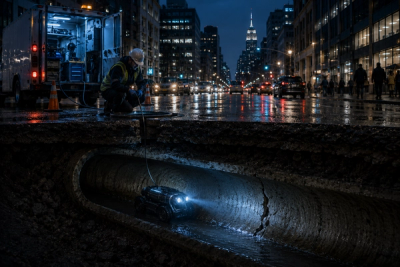
Modern sewer inspection requires two distinct capabilities. The first is mechanical and operational: safely deploying equipment, navigating pipe networks, managing cables and crawlers, and capturing clear video. The second is analytical: identifying defects in real time, interpreting their severity, and coding them accurately according to established standards.
Historically, field operators were expected to do both simultaneously. A resilient workforce model separates these responsibilities. Operators focus on capturing high-quality inspection footage and maintaining safe job-site practices. Automated analysis and structured quality control processes handle the detailed classification and defect coding downstream.
This shift has measurable effects. New hires with appropriate certification and safety training can become productive much more quickly. In practical terms, a 23-year-old new hire with the proper safety training and equipment familiarity can generate inspection data that feeds into a rigorous, standardized analytical workflow. The system absorbs the classification complexity that once demanded years of experience in the field.
The problem: Traditional inspection workflows require operators to perform complex defect analysis in real time while executing demanding field tasks, creating long learning curves and limiting the pool of personnel capable of delivering consistent outputs.
The 100-year vision solution: A structured inspection model that separates capture from classification, embedding analytical rigor into the system so output quality remains consistent regardless of individual experience levels.
Section 2 — Creating Workforce Flexibility Through Structured Workflows
Resiliency is closely tied to flexibility. Utilities and contractors face staffing variability due to retirements, sick leave, turnover, and hiring constraints. When inspection quality depends heavily on a small number of highly specialized individuals, operational stability becomes fragile.
Structured inspection platforms improve this dynamic. Map-based job assignments, pre-populated inspection forms, and integrated workflows reduce manual transcription and redundant data entry. Crews can be deployed across multiple roles with greater confidence because the system guides key steps and enforces consistency.
For public works departments, this flexibility allows cross-training between equipment types and project scopes without requiring every employee to master advanced defect classification. For contractors, it increases the ability to allocate labor efficiently across jetting, inspection, and rehabilitation projects.
Workforce flexibility also mitigates the impact of turnover. When knowledge of how to document and classify conditions is embedded in the platform, replacing or reassigning personnel does not disrupt output quality to the same degree.
The problem: When inspection accuracy depends on a limited number of highly specialized operators, workforce turnover or absence can significantly disrupt productivity and compromise data quality.
The 100-year vision solution: Structured, system-guided workflows that distribute expertise across the organization, enabling flexible crew deployment without sacrificing inspection quality.
Section 3 — Delivering Consistent Outputs at Scale
Even with standardized training, human interpretation varies. If five trained professionals review the same inspection video independently, they are likely to produce different outputs. These differences may be subtle, but across thousands of inspections, they compound into meaningful variability in the dataset.
At scale, this variability undermines confidence in inspection results. Engineers reviewing reports may question whether a change in defect counts reflects true deterioration or simply differences in interpretation.
Computer vision-based classification and structured quality control processes reduce this variability. Automated detection applies the same analytical criteria across every inspection. Quality control reviews ensure that outputs meet standardized thresholds before being finalized.
Consistency does not eliminate professional judgment; rather, it establishes a stable analytical baseline. Over time, this produces a dataset that is more defensible, more comparable, and more useful for long-term planning.
The problem: Manual inspection workflows introduce interpretation variability across operators, reducing dataset consistency and complicating long-term asset management decisions.
The 100-year vision solution: Standardized, automated analysis supported by structured quality control, producing consistent inspection outputs that enable defensible, systemwide decision-making.
Section 4 — Reducing Cognitive Burden in the Field to Improve Safety and Performance
Sewer inspection is conducted in environments that demand constant situational awareness. Crews manage traffic control setups, confined spaces, gas monitoring, equipment operation, and team coordination. Traffic exposure remains one of the most significant safety risks in CCTV operations.
Requiring operators to simultaneously interpret defects and enter detailed annotations during live inspections divides attention. It increases cognitive load in an environment where distraction can have serious consequences.
By transferring classification tasks to automated systems and structured review processes, operators can devote greater attention to equipment performance, job-site conditions, and crew communication. Reduced inspection time per site further decreases exposure to traffic-related hazards. Operational efficiency, data quality, and safety become mutually reinforcing rather than competing priorities.
The problem: Overloading field operators with real-time analytical tasks increases cognitive strain, prolongs job-site exposure, and elevates safety risks in already hazardous environments.
The 100-year vision solution: Field workflows that prioritize safe execution and situational awareness, supported by automated analytical systems that remove unnecessary cognitive burden.
Section 5 — Preserving Institutional Knowledge During Workforce Transition
Many sewer departments and contractors are experiencing significant demographic shifts. Experienced operators with decades of field knowledge are approaching retirement. Their understanding of system behavior, recurring trouble spots, and effective interventions represents substantial institutional value.
Traditional knowledge transfer relies heavily on informal mentorship and on-the-job exposure. Embedding classification standards and structured review processes within inspection systems helps mitigate institutional brain drain. Expertise becomes part of the workflow rather than residing exclusively with individuals.
Programs such as structured onboarding sessions, searchable knowledge repositories, and recurring technical webinars create multiple channels for knowledge reinforcement. As new staff enter the organization, they interact with documented processes and standardized outputs rather than relying solely on inherited habits. Over time, this approach ensures that organizational knowledge compounds instead of eroding.
The problem: As experienced personnel retire, insufficiently structured knowledge transfer mechanisms result in institutional brain drain and declining inspection consistency.
The 100-year vision solution: Inspection systems that embed standards and preserve institutional knowledge, ensuring continuity and stability across generational workforce transitions.
Section 6 — Aligning Technology with the Expectations of the Emerging Workforce
Workforce expectations are evolving across industries. Younger employees entering infrastructure roles are accustomed to digital tools, automation, and structured workflows. Organizations that provide modern systems signal investment in efficiency and professional development.
In other sectors, advanced software platforms are considered foundational rather than optional. Sewer inspection workflows are undergoing a similar transition. Structured platforms and automated analysis are becoming part of the baseline operational environment. Organizations that adopt these tools position themselves to recruit and retain talent more effectively.
Modern tools also support performance transparency. Operators can see structured outputs and understand how their work contributes to larger planning decisions. Adopting contemporary workflows is therefore not solely a technological decision; it is also a workforce strategy.
The problem: Organizations that rely exclusively on legacy manual workflows risk falling behind in recruitment, retention, and operational efficiency as workforce expectations evolve.
The 100-year vision solution: Modern, integrated inspection systems that align with contemporary workforce expectations and position organizations to attract and retain capable talent.
Section 7 — Building Workforce Resiliency as a Strategic Asset
When inspection workflows are structured, automated, and supported by consistent quality control, workforce resiliency becomes measurable. Output quality stabilizes across crews. Planning becomes more reliable because inspection data is consistent. Managers can allocate personnel with greater confidence.
This resilience extends beyond immediate operational efficiency. It strengthens long-term planning by ensuring that inspection datasets remain stable even as staffing changes. It supports safety by reducing cognitive strain. It enhances flexibility by lowering dependence on specialized individuals.
A resilient workforce model does not eliminate the value of experience. Rather, it ensures that experience enhances the system instead of being a prerequisite for its stability. Over time, organizations that embed expertise into workflows gain strategic advantage. They can absorb workforce fluctuations without sacrificing performance, maintain inspection volumes, and support data-driven capital planning.
The problem: Without embedded workflow intelligence and standardized outputs, inspection programs remain fragile and overly dependent on specific individuals.
The 100-year vision solution: A resilient, system-centered inspection model that delivers expert-level outcomes consistently, regardless of workforce turnover or individual variability.
Conclusion
The sewer industry is entering a period of sustained workforce transition. Aging infrastructure, regulatory pressure, and staffing variability will define the coming decades. Maintaining performance under these conditions requires more than incremental training improvements.
A resilient workforce model embeds expertise into structured workflows, reduces variability, and supports safety and flexibility in the field. By lowering skill barriers without lowering output quality, utilities and contractors can stabilize inspection programs and maintain confidence in their data.
Workforce resiliency is not achieved by preserving the status quo. It is achieved by redesigning inspection systems so they produce consistent, defensible outcomes regardless of who is on shift. In an industry built to serve generations, the durability of the workforce model is as important as the durability of the infrastructure itself.
Read the Full Whitepaper
Download the full SewerAI whitepaper — Building a Resilient Sewer Workforce in the Age of Automation — for the complete framework, detailed analysis, and actionable guidance for building a durable inspection program.


STAY AHEAD OF THE FLOW
Get SewerAI updates, product news, and practical guidance for modern sewer inspection programs.