Inside the Sewer Infrastructure Ecosystem: Getting Utilities, Contractors, and Engineers on the Same Record
In sewer inspection programs, data is routinely touched, manipulated, and re-reviewed 3–4 times as it moves from field crew to contractor to engineer to utility — a broken handoff chain that erodes trust and delays critical decisions. SewerAI's approach separates mechanical capture from analytical classification, embedding consistency directly into the workflow so operations leaders get the right experts to the right decisions faster. Utilities like the City of Houston and the Village of Schaumburg have already seen what's possible when the process stops fighting itself.
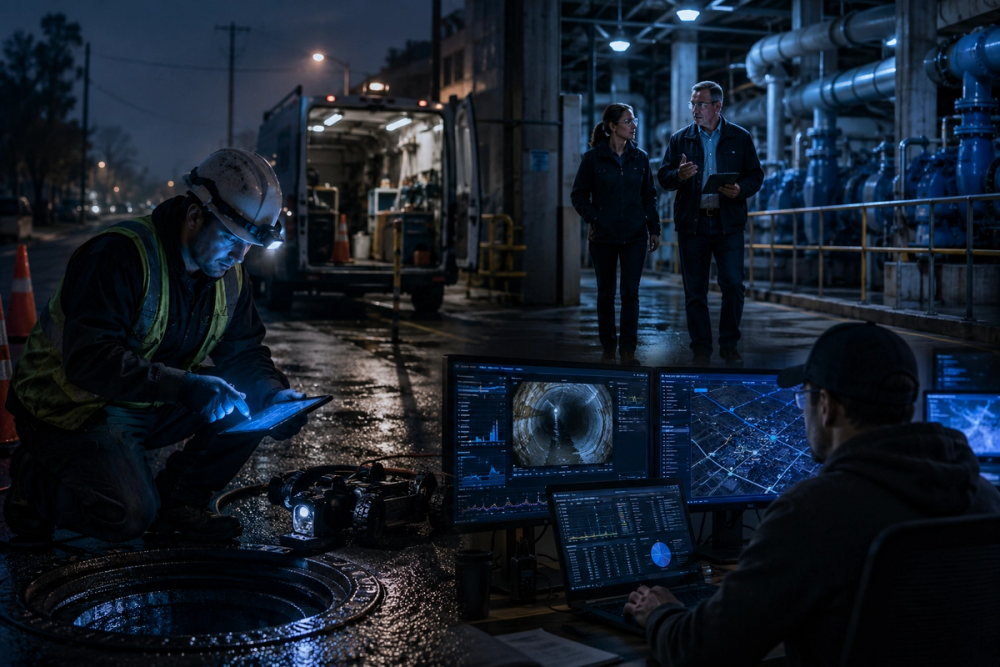
This post summarizes key findings from our latest whitepaper. Download the full whitepaper here.
The Sewer Inspection Data Problem: A Broken Handoff Chain
Every year, utilities spend millions of dollars inspecting sewer infrastructure — deploying field crews, running CCTV cameras through hundreds of miles of pipe, and generating terabytes of video footage. Yet despite this enormous investment, the data that ultimately reaches the utility’s asset management system is often unreliable, inconsistent, and incomplete. The reason isn’t a lack of effort. It’s a broken handoff chain.
In the traditional sewer inspection workflow, data passes through at least four distinct hands before it reaches the people who need to act on it: the field crew captures the video, the contractor’s office reviews and codes it, an engineering consultant re-reviews and interprets it, and finally the utility receives a report. At each step, the data is touched, manipulated, and re-reviewed. At each step, trust erodes a little more.
This whitepaper examines why that erosion happens, what it costs utilities and their communities, and how a new generation of AI-powered inspection platforms is fundamentally changing the equation — not by adding another layer of review, but by removing the variability that makes multiple reviews necessary in the first place.
The Core Problem: Variability is Systemic
The sewer inspection industry has long operated on a foundation of human judgment. Trained technicians watch hours of pipe video and apply defect codes according to standards like NASSCO’s Pipeline Assessment Certification Program (PACP). In theory, standardized coding should produce consistent results. In practice, it rarely does.
Human interpretation varies — between technicians, between companies, between regions, and even within the same individual across different days and different levels of fatigue. A crack that one coder grades as a Grade 3 structural defect might be coded as Grade 2 by another. A root intrusion that one technician flags as operationally significant might be overlooked entirely by someone working under time pressure. These aren’t failures of training or intent. They are the inevitable result of asking humans to make hundreds of subjective micro-decisions per inspection, at scale, under production pressure.
The consequences compound as data moves through the handoff chain. When the contractor’s office reviews field-coded data, they often make corrections. When the engineering consultant reviews the contractor’s output, they make more corrections. By the time the data reaches the utility, it may bear little resemblance to what was originally captured in the field.
As Tim McGarry, Director of Sales at SewerAI, puts it: “By the time it makes it back to the utility, the video often doesn’t match what’s in the database. There’s been all these corrections made.”
The result is a utility that cannot fully trust its own inspection data — and therefore cannot make confident, defensible decisions about where to invest its capital. When inspection accuracy depends on individual interpretation, the same decisions get mulled over multiple times before anyone acts. Reviews pile on top of reviews. Timelines stretch. And critical infrastructure risk goes undetected.
The Solution: Separating Capture from Classification
SewerAI’s approach to this problem is conceptually straightforward but operationally transformative: separate the act of mechanical capture from the act of analytical classification.
In the traditional model, these two activities are fused together. The field technician who operates the CCTV camera is also responsible for coding what the camera sees — in real time, under production pressure, with limited ability to pause, rewind, or cross-reference. This fusion is the root cause of variability. It asks a single person to simultaneously operate equipment, navigate the pipe environment, and make precise analytical judgments.
SewerAI breaks this fusion. Field crews focus exclusively on what they do best: capturing high-quality video footage. The analytical work — defect identification, PACP coding, severity grading — is handled downstream by SewerAI’s AI-powered AutoCode engine, which applies consistent classification logic to every frame of every inspection, without fatigue, without distraction, and without the day-to-day variability that characterizes human coding.
This isn’t simply automation for automation’s sake. It’s a structural redesign of the workflow that embeds consistency into the process itself. When the classification logic is the same for every inspection — whether it’s the first pipe of the day or the five hundredth — the data that emerges from the process is genuinely comparable. Utilities can trust that a Grade 4 defect in one part of their system was identified using the same criteria as a Grade 4 defect in another. That comparability is the foundation of sound capital planning.
SewerAI’s Platform: Three Pillars, One Record
SewerAI’s platform is built around three integrated tools, each designed to address a specific stage of the inspection and asset management lifecycle.
Pioneer: Data and Project Management
Pioneer is SewerAI’s data and project management layer — the system of record that connects field activity to office workflows. It provides real-time visibility into inspection progress, manages data quality at the point of capture, and ensures that video footage and associated metadata are organized, accessible, and audit-ready. For utilities managing large inspection programs across multiple contractors, Pioneer eliminates the data chaos that typically accompanies multi-vendor programs.
AutoCode: AI-Powered Defect Coding
AutoCode is the analytical engine at the heart of SewerAI’s platform. Using computer vision models trained on millions of pipe inspection frames, AutoCode identifies and codes defects according to PACP standards with 97% accuracy — a level of consistency that no human coding operation can match at scale. AutoCode doesn’t replace the expertise of engineers and asset managers; it gets them to the five-yard line of the decision faster, so their judgment is applied where it matters most: interpreting findings, prioritizing action, and communicating risk to stakeholders.
Risk & Rehab: Capital Planning
Risk & Rehab translates inspection findings into capital planning intelligence. By aggregating defect data across an entire pipe network, it enables utilities to prioritize rehabilitation investments based on actual condition data rather than age-based assumptions or reactive maintenance patterns. For utilities facing multi-billion-dollar infrastructure backlogs, this kind of data-driven prioritization isn’t a nice-to-have — it’s a fiscal necessity.
Together, these three tools create a single, trusted record that utilities, contractors, and engineers can all work from — eliminating the version-control problems and trust deficits that plague traditional inspection workflows.
Case Study: City of Houston
The City of Houston operates one of the largest and most complex sewer systems in the United States, with thousands of miles of pipe serving a rapidly growing metropolitan area. Managing that system requires not just inspection capacity, but inspection intelligence — the ability to turn raw video footage into actionable condition data at a pace that keeps up with the city’s growth.
Since deploying SewerAI’s platform, Houston has achieved results that demonstrate what’s possible when AI-powered consistency replaces manual variability:
- 53% increase in inspected miles per year — more pipe assessed, more risk identified, more decisions made with confidence
- 97% defect coding accuracy — a consistent, auditable standard applied across every inspection in the program
- $1 million per year in staff augmentation savings — resources redirected from manual review to higher-value engineering and planning work
- Support for $6 billion in planned infrastructure investments — capital decisions grounded in reliable, comparable condition data
These aren’t incremental improvements. They represent a fundamental shift in what a utility inspection program can accomplish — and what it can justify to ratepayers, regulators, and elected officials.
Case Study: Village of Schaumburg
If Houston illustrates the scale at which SewerAI’s platform can operate, the Village of Schaumburg illustrates something equally important: the hidden cost of manual inspection processes.
Schaumburg is a mid-sized municipality in the Chicago suburbs with a well-managed public works program. When the village deployed SewerAI’s AutoCode on a portion of its inspection data, the results were striking — and sobering.
AutoCode identified more than 600% more Grade 4 and Grade 5 defects than the village’s manual coding process had detected. For structural defects specifically — the category most directly associated with pipe failure, sinkholes, and service disruption — AutoCode found more than 1,400% more than manual review had surfaced.
These weren’t defects that didn’t exist in the manual data. They were defects that existed in the video footage but were missed, under-coded, or inconsistently classified by human reviewers. The pipes were the same. The cameras were the same. The difference was the consistency and thoroughness of the analytical process.
For Schaumburg, this finding had immediate practical implications: infrastructure risk that had been invisible to the capital planning process was suddenly visible. Rehabilitation priorities that had been based on incomplete data could be recalibrated. And the village could make a defensible case to its governing board for investment decisions grounded in actual pipe condition rather than assumptions.
Schaumburg’s experience is not an outlier. It is a window into a systemic problem that affects utilities of every size: manual inspection processes don’t just introduce variability — they systematically under-detect critical infrastructure risk. The defects are there. The question is whether your data process is capable of finding them.
The Future of Sewer Infrastructure Management
The sewer infrastructure challenge facing utilities across North America is not going away. Aging pipe networks, growing service populations, tightening regulatory requirements, and constrained capital budgets are converging to create a management environment that demands more from inspection data than the traditional workflow can deliver.
The utilities that will navigate this environment most successfully are those that recognize inspection data not as a compliance output but as a strategic asset — one that, when properly captured, classified, and analyzed, can drive defensible capital decisions, optimize contractor performance, and build the kind of institutional trust that sustains long-term infrastructure programs.
That requires utilities, contractors, and engineers to operate from a single, trusted record. It requires a workflow where data quality is built in, not bolted on. It requires separating the mechanical work of capture from the analytical work of classification, and applying consistent, auditable logic to every inspection in the program.
SewerAI’s platform makes that possible at scale. From the field crew running the camera to the engineer prioritizing the capital plan, every stakeholder in the inspection ecosystem works from the same data, coded to the same standard, with the same confidence in what it means.
The broken handoff chain doesn’t have to be the way things work. With the right platform, it can be replaced by something better: a single record that everyone trusts, and that everyone can act on.
Ready to go deeper? Download the full whitepaper to see how utilities, contractors, and engineers can get on the same record — and what that means for your inspection program.
STAY AHEAD OF THE FLOW
Get SewerAI updates, product news, and practical guidance for modern sewer inspection programs.