Would You Know Before It Broke?
Eight million gallons of untreated wastewater in the Merrimack River. Five closed beaches. One aging force main. The lesson from Haverhill isn't about what tool was missing. It's about a posture every utility can still choose to change.
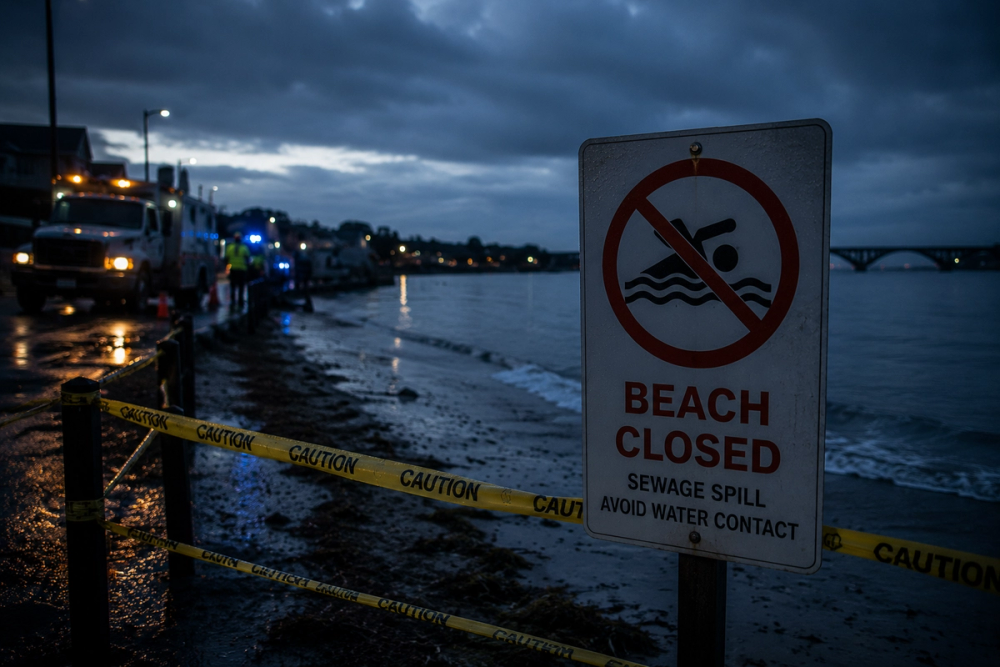
Over the weekend, an estimated eight million gallons of untreated wastewater flowed into the Merrimack River every day, and five towns on Massachusetts' North Shore closed their beaches to swimmers on one of the busiest holiday weekends of the year. As NBC Boston reported, the cause was a break in a 42-inch force main in Haverhill. The mayor described the pipe and the plant it feeds in two words: aging infrastructure. They date to the early 1970s.
The crews from Xylem, the construction and engineering teams on site, the state agencies that mobilized within hours: those are the people who ran toward this. They stood up a temporary bypass in a matter of days and kept a bad weekend from becoming a much worse one. Anyone who has done emergency work in a collection system knows exactly what that takes.
And the pipe itself deserves a fair hearing. No camera crawler catches a force main under a sudden storm load. This was not a case of the wrong gadget. So the question worth carrying out of Haverhill isn't what tool was missing there. It's what posture the rest of us are carrying everywhere else.
Most systems meet their oldest assets on the worst possible day
The pipe in Haverhill was roughly fifty years old. That is not unusual. That is the norm. A huge share of the collection system in this country went into the ground between the 1950s and the 1970s, which means a huge share of it is now reaching the end of a life nobody has looked at closely in decades. For a lot of systems, the first detailed condition assessment a critical asset ever gets is the forensic one, after it fails, when engineers climb inside to work out what happened. Haverhill's own team said the real repair will take months, precisely because that assessment has to happen before they can fix it properly.
The inspection that matters most is often the one that happens after the break. That is the pattern worth naming, because it is not a Haverhill problem. It is close to a national default. We inspect what we can get to, we fix what has already announced itself, and we carry the rest as an assumption. The assumption holds right up until it doesn't, and then it holds a press conference.
The reactive posture has a price, and everyone downstream pays it
When a system fails without warning, the bill does not arrive as one number. It arrives as closed beaches during a heat wave, as shellfish beds shut down as a precaution, as businesses and families who planned around a coastline they suddenly can't use, as an emergency repair that costs a multiple of what a planned one would have. None of that lands in a capital plan, because none of it was planned. That is the whole point.
The alternative isn't heroic. It's boring, in the best sense. It means knowing the condition of your system well enough to rank it, and rehabilitating the worst of it on a schedule you chose instead of one a rainstorm chose for you.
The tools to change the posture are already here, and they are not exotic
Here is the part that should feel like ground gained, not ground lost. The reason condition assessment used to lag failure was cost and speed. Inspecting and coding a large system by hand took so long and cost so much that most utilities could only ever look at a sliver of it. That math has changed. AI-assisted coding now moves through footage fast enough to make system-wide assessment realistic instead of aspirational, which means the condition data can finally be current enough to plan from.
And once the data is current, you can do the thing that actually heads off the Haverhill weekend: prioritize. Not "inspect everything and hope." Rank every asset by the risk it carries and the cost of its failure, then put your rehab dollars on the pipes most likely to close a beach before they close it. That is exactly what our Risk & Rehab tool is for, and it was built with utilities who are living this exact problem.
The lesson of Haverhill isn't that everyone needs to buy something. It's quieter and harder than that. The reactive posture is a choice, even when it doesn't feel like one, and it is a choice more utilities can now afford to stop making.
So the question worth sitting with this week is not "could this happen to us." It almost certainly could. The better one is the question Haverhill's team is answering the hard way right now: would you know before it broke?
If the honest answer is no, that isn't a failing. It's just the next thing to fix. And unlike a force main under storm load, it's entirely visible from here.
Subscribe to the SewerAI blog. New post every Monday. Built for the people doing the work.
STAY AHEAD OF THE FLOW
Get SewerAI updates, product news, and practical guidance for modern sewer inspection programs.